Lincoln Public Schools


Rights and Responsibilities of Students

To download printable versions of the Responsibilities of Students, please click on the language you would like to print it in.

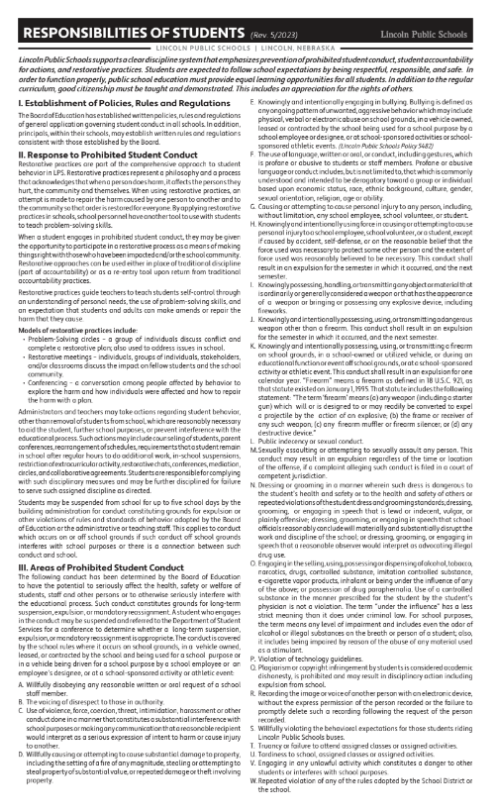
In order to function properly, public school education must provide an equal learning opportunity for all students. In addition to the regular curriculum, good citizenship must be taught and demonstrated. This includes an appre- ciation for the rights of others.

I. Establishment of Policies, Rules and Regulations

The Board of Education has established written policies, rules and regulations of general application governing student conduct in all schools. In addition, principals, within their schools, may establish written rules and regulations not inconsistent with those established by the Board.

II. Areas of Prohibited Student Conduct

Students are not to engage in conduct which causes or which creates a reasonable likelihood that it will cause a substantial disruption in or material interference with any school, function, activity or purpose or interfere with the health, safety, well being or the rights of other students, staff or visitors.

The following conduct has been determined by the Board of Education to have the potential to seriously affect the health, safety or welfare of students, staff and other persons or to otherwise seriously interfere with the educational process. Such conduct constitutes grounds for long-term suspension,expulsion,ormandatoryreassignment. Astudentwhoengages in the conduct may be suspended and referred to the Department of Student Services for a conference to determine whether a long-term suspension, ex- pulsion, or mandatory reassignment is appropriate. The conduct is covered by the school rules where it occurs on school grounds, in a vehicle owned, leased, or contracted by the school and being used for a school purpose or in a vehicle being driven for a school purpose by a school employee or an employee’s designee, or at a school-sponsored activity or athletic event:

A. Willfullydisobeyinganyreasonablewrittenororalrequestofaschoolstaff member, or the voicing of disrespect to those in authority.

B. Useofviolence,force,coercion,threat,intimidation,bullying,harassment or similar conduct in a manner that constitutes a substantial interference with school purposes or making any communication that reasonable recipient would interpret as a serious expression of intent to harm or cause injury to another.

C. Willfully causing or attempting to cause substantial damage to property, including the setting of a fire of any magnitude, stealing or attempting to steal property of substantial value, or repeated damage or theft involving property.

D. Causing or attempting to cause personal injury to any person, including, without limitation, any school employee, school volunteer, or student.

E. Threateningorintimidatinganystudentforthepurposeof,orwiththeintentof, obtaining money or anything of value from such student, or making a threat which causes or may be expected to cause a disruption to school operations.

F. Knowinglypossessing,handling,ortransmittinganyobjectormaterialthat is ordinarily or generally considered a weapon or that has the appearance of a weapon or bringing or possessing any explosive device, including fireworks.

G. Engaging in the selling, using, possessing or dispensing of alcohol, tobacco, narcotics, drugs, controlled substance, inhalant or being under the influence of any of the above; or possession of drug paraphernalia. Use of a controlled substance in the manner prescribed for the student by the student’ s physician is not a violation. The term “under the influence” has a less strict meaning than it does under criminal law. For school purposes, the term means any level of impairment and includes even the odor of alcohol or illegal sub- stances on the breath or person of a student; also, it includes being impaired by reason of the abuse of any material used as a stimulant.

H. Engaging in the selling, using, possessing, or dispensing of an imitation controlled substance as defined in Section 28-401, of the Nebraska statutes, or material represented to be alcohol, narcotics, drugs, controlled substance or inhalant.

I. Truancy or failure to attend assigned classes or assigned activities.

J. Tardiness to school, assigned classes or assigned activities.

K. The use of language, written or oral, or conduct, including gestures, whichis profane or abusive to students or staff members. Profane or abusive language or conduct includes, but is not limited to, that which is commonly understood and intended to be derogatory toward a group or individual based upon economic status, race, ethnic background, culture, gender, sexual orientation, religion, age or ability.

L. Publicindecencyorsexualconduct.

M. Repeated violation of any of the rules adopted by the School District or theschool.

N. Engaging in any unlawful activity which constitutes a danger to otherstudents or interferes with school purposes.

O. Dressing or grooming in a manner wherein such dress is dangerous to thestudent’s health and safety or to the health and safety of others or repeated violations of the student dress and grooming standards; dressing, grooming, or engaging in speech that is lewd or indecent, vulgar, or plainly offensive; dressing, grooming, or engaging in speech that school officials reasonably conclude will materially and substantially disrupt the work and discipline of the school; or dressing, grooming, or engaging in speech that a reasonable observer would interpret as advocating illegal drug use.

P. Willfully violating the behavioral expectations for those students riding Lincoln Public Schools buses.

Q. Sexually assaulting or attempting to sexually assault any person. This conduct may result in an expulsion regardless of the time or location of the offense, if a complaint alleging such conduct is filed in a court of competent jurisdiction.

R. Knowinglyandintentionallyusingforceincausingorattemptingtocause personal injury to a school employee, school volunteer, or a student, except if caused by accident, self-defense, or on the reasonable belief that the force used was necessary to protect some other person and the extent of force used was reasonably believed to be necessary. This conduct shall result in an expulsion for the semester in which it occurred, and the next semester.

S. Knowinglyandintentionallypossessing,using,ortransmittingadangerous weapon other than a firearm. This conduct shall result in an expulsion for the semester in which it occurred, and the next semester.

T. Knowingly and intentionally possessing, using, or transmitting a firearm on school grounds, in a school-owned or utilized vehicle, or during an educational function or event off school grounds, or at a school- sponsored activity or athletic event. This conduct shall result in an expulsion for one calendar year. “Firearm” means a firearm as defined in 18 U.S.C. 921, as that statute existed on January 1, 1995. That statute includes the following statement: “The term ‘firearm’ means (a) any weapon (including a starter gun) which will or is designed to or may readily be converted to expel a projectile by the action of an explosive; (b) the frame or receiver of any such weapon; (c) any firearm muffler or firearm silencer; or (d) any destructive device.”

Students may also be suspended from school for up to five school days by the building administration for conduct constituting grounds for expulsion or other violations of rules and standards of behavior adopted by the Board of Education or the administrative or teaching staff which occur on or off school grounds if such conduct interferes with school purposes or there is a connection between such conduct and school.

In addition, administrators and teachers may also take actions regarding student behavior, other than removal of students from school, which are reasonably necessary to aid the student, further school purposes, or prevent interference with the educational process. Such actions may include counseling of students, parent conferences, rearrangement of schedules, requirements that a student remain in school after regular hours to do additional work, in-school suspen- sions, or restriction of extracurricular activity. Students are responsible for complying with such disciplinary measures and may be further disciplined for a failure to serve such assigned discipline as directed.